What If There Was a Better Way to Heal Broken Ribs?
A Penn State-developed system is helping patients breathe easier and heal faster.
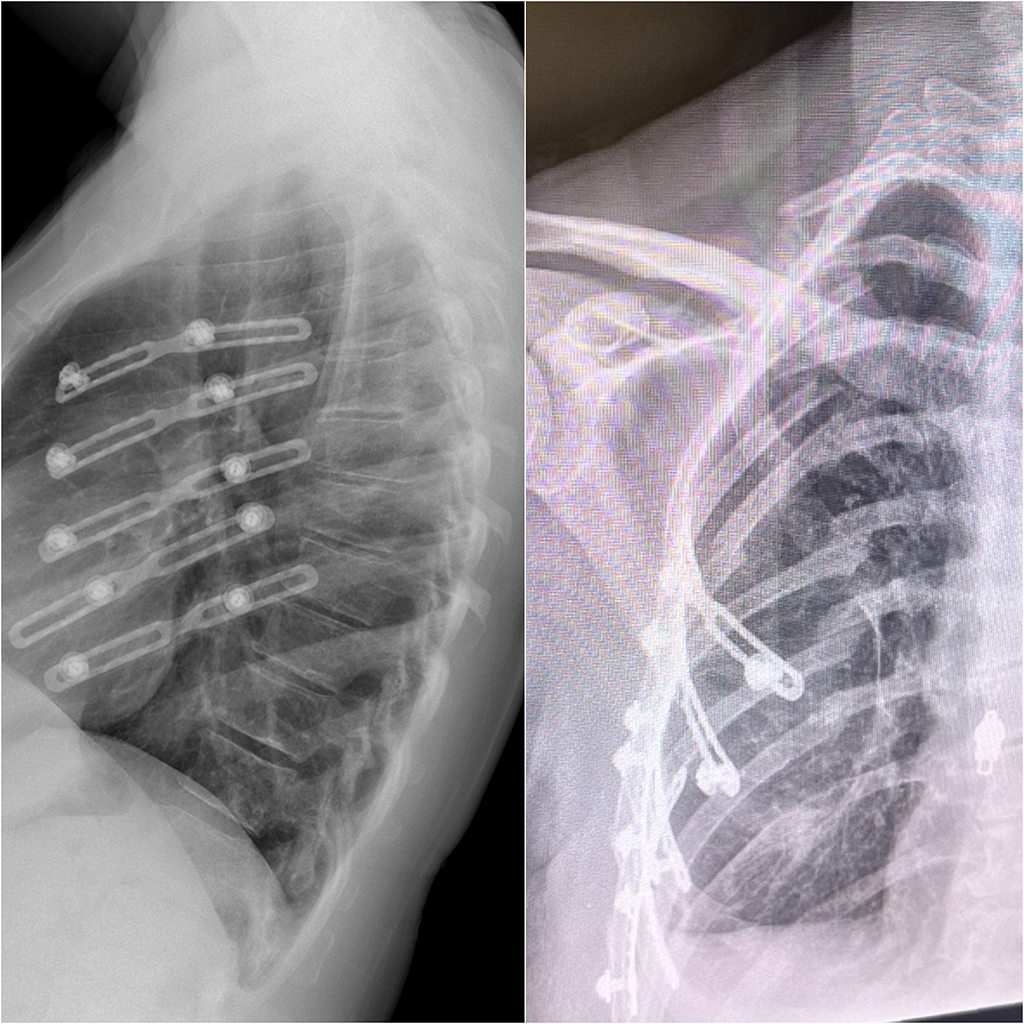
X-ray images show the innovative RibFix Advantage system in place, which helped repair Nancy Rehm's shattered ribs and accelerate her recovery.
Impact in Brief
Penn State-developed medical device transforms trauma care: RibFix Advantage, the first FDA-cleared rib fixation system, reduces surgery time, hospital stays, and complications for the hundreds of thousands of Americans who suffer broken ribs annually.
Innovation addresses significant public health burden: The device tackles pneumonia risk and lung collapse complications in rib fracture patients—particularly critical for older adults and relevant to Medicare cost and quality-of-care initiatives.
University research commercialization success: Penn State College of Medicine faculty developed and licensed the technology through the Office of Technology Transfer, demonstrating how academic medical centers contribute to healthcare innovation and economic development.
Less invasive procedure improves patient outcomes: RibFix requires only three small incisions versus traditional armpit-to-waist surgery, enabling faster recoveries and reducing healthcare system costs—a priority for value-based care models.
Broken ribs mean agonizing pain with every breath. But for one athlete, a life-threatening crash led to a remarkable recovery—thanks to a medical innovation developed at Penn State and licensed to industry by the Office of Technology Transfer.
A Life Changed in an Instant
Nancy Rehm, an accomplished multi-sport endurance athlete, was one mile from finishing a 51-mile bike tour in Waco, Texas, when she was involved in a near-fatal collision with an SUV. Thrown twenty feet and knocked unconscious, her life changed in an instant.
She arrived at a trauma center in critical condition with a concussion, a broken shoulder, and the right side of her chest shattered. Her lungs struggled to inflate, allowing blood and air to collect in her chest cavity and putting her life in immediate danger.
“It was a very scary situation not knowing what was going to happen,” Rehm recalled. She wondered if she would ever breathe normally again—or return to the active life she loved.
To give Rehm the best chance at recovery, her trauma surgeon turned to RibFix Advantage—a groundbreaking medical system for repairing broken ribs developed at Penn State.
“What researchers and doctors like Drs. Haluck, Mackay, and Dillon do matters. It changes people’s lives and the lives of the family and friends around them,” said Rehm.
What researchers and doctors like Drs. Haluck, Mackay, and Dillon do matters. It changes people's lives and the lives of the family and friends around them."
The Challenge: Fixing Broken Ribs Isn’t Easy
Ribs act as a protective cage for vital organs like the heart and lungs. When they break, every breath becomes agonizing. Each year, hundreds of thousands of people experience broken ribs. The pain makes it difficult to breathe deeply, leaving patients vulnerable to pneumonia or even lung collapse.
“A single rib fracture can cause tremendous disability. They’re painful and bring high risk for pneumonia, which can be life-threatening, especially for older adults,” said Randy Haluck, professor of surgery and vice chair of technology at the Penn State College of Medicine, who was part of the team that developed RibFix Advantage.
Traditional rib repair surgeries are invasive and demanding. Surgeons must make long incisions—from the armpit to the waist—to attach metal plates to the outer surface of the bone. Because the procedure is so difficult, it’s usually reserved for patients with multiple fractures.
Rehm’s case was among the most severe: nine broken ribs, seven fractured in multiple places, severely limiting her ability to breathe.
“The immediate aftermath marked some of my darkest days both mentally and physically. I didn’t know how to move forward,” she said. Doctors warned that traditional surgery could leave her with lifelong pain, making even simple movements difficult—let alone a return to triathlons.
A Better, Faster Way to Heal
Years before Rehm’s accident, physicians at the Penn State College of Medicine and Penn State Health Milton S. Hershey Medical Center recognized the need for a safer, more effective way to repair ribs.
Dr. Haluck, along with Dr. Donald Mackay, professor of surgery, neurosurgery, and orthopedics and rehabilitation, and Dr. Peter Dillon, former chief of surgery and current executive vice president and chief clinical officer at Penn State Health, developed a new idea: what if the plate could be attached to the inner surface of the broken rib instead of the outer one?
“The ribs are like a stone bridge. They do their job as long as the arch is intact, but as soon as you break the arch, it doesn’t function anymore,” Haluck explained. “By positioning the plate on the underside of the rib, it’s like pushing the stone back up and into the arch, restoring the arch’s structure.”
Their invention became RibFix Advantage, the first rib fixation system cleared by the U.S. Food and Drug Administration (FDA) and used to help patients recover from broken ribs.
Nancy Rehm's active lifestyle is a family affair, seen here sharing a moment with her daughter during an open-water swim in Canada.
After a long and difficult recovery, Nancy Rehm is back doing what she loves, cycling with her husband.
X-ray images show the innovative RibFix Advantage system in place, which helped repair Nancy Rehm's shattered ribs and accelerate her recovery.
Nancy Rehm's passion for triathlons shines through as she races in an Ironman event in Lubbock, Texas.
Less than ten months after her accident, Nancy Rehm proudly competed at the World Triathlon Multisport World Championships in Spain.
A New Standard in Trauma Care
RibFix represented a major advancement in trauma care. The procedure was less invasive, required only three small incisions, and could be completed in under an hour. Patients experienced fewer complications, shorter hospital stays, and faster recoveries.
While healing from both surgery and the trauma of the accident was challenging, Rehm’s recovery surpassed expectations.
“Every medical professional I’ve encountered along the way is beyond shocked at the pace of my recovery,” she said. “They say that they wouldn’t normally see this kind of improvement at all, let alone within five or six months.”
She described crossing the finish line as “a dream come true.”
A Lasting Impact
Today, RibFix Advantage is improving outcomes for trauma patients across the country. For Rehm, it meant a second chance at life—and a return to the sport she loves.
“RibFix gave me a chance to improve my situation and that’s huge,” Rehm said. “I’m so grateful that the doctors at Penn State thought that there had to be a better way.”
Are you interested in learning more about technology and intellectual property developed at Penn State that is available for licensing and industry development? Visit the Office of Technology Transfer at ott.psu.edu to learn more.
Partner with Penn State Research
From cooperative research, to workforce development, to cutting-edge facilities, Penn State helps businesses and organizations around the globe. Want to connect with us?